Sensors, Actuators and Energy Conversion
What Are Transducers?
Transducers are devices that convert one form of energy, motion, force, pressure, sound, light, temperature, or electrical signal into another usable signal or action.
How Transducers Work
A transducer acts as an interface between the physical world and an electrical, mechanical, optical, or acoustic system. Sensors are input transducers: they detect a physical quantity and convert it into a signal that can be measured or processed. Actuators are output transducers: they convert an electrical command into motion, force, vibration, sound, or another physical effect.
Common examples include microphones, ultrasonic transducers, pressure sensors, accelerometers, piezo actuators, loudspeakers, temperature sensors, and position feedback devices.
Where Transducers Are Used
Medical Technology
Ultrasound imaging, drug delivery, surgical tools, micro-pumps, diagnostic systems, and compact medical devices.
Industrial Automation
Force measurement, vibration monitoring, precision positioning, process control, ultrasonic welding, and machine feedback.
Optics and Photonics
Fast alignment, beam steering, lens positioning, fiber coupling, scanning systems, and high-stability motion control.
Nano-Precision Transducers
Nano-precision transducers are designed for applications where extremely small motion, force, vibration, or sensing changes must be controlled with nanometer or sub-nanometer resolution. Piezoelectric transducers are especially useful because they are compact, solid-state, fast, and capable of very fine motion without gears or mechanical backlash.
They are used in semiconductor tools, microscopy, photonics alignment, medical devices, precision metrology, microfluidics, aerospace instrumentation, and advanced research systems.
What Are Piezoelectric Ultrasonic Transducers
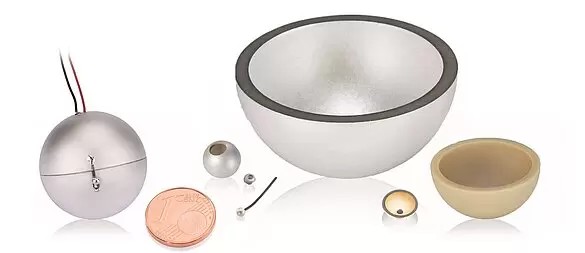
Piezoelectric spheres and hemispheres used in focused ultrasound, HIFU, medical imaging, sensing, and industrial ultrasonic applications.
Ultrasonic transducers convert electrical energy into high-frequency mechanical vibration and convert returning acoustic waves back into electrical signals. Most precision ultrasound transducers are based on piezoelectric materials, which expand and contract when driven by an electrical signal and generate a voltage when mechanically stressed by returning sound waves.
Because of the high frequency range (which is above the range of human hearing), these devices are well suited to transmit energy, detect reflections, measure distance, image internal structures, or deliver localized mechanical vibration without visible motion. The exact design depends on the required frequency, acoustic power, sensitivity, aperture size, beam shape, and operating environment.
Medical Imaging and Therapy
Diagnostic ultrasound probes, intravascular imaging, focused ultrasound therapy, often called HIFU (High-Intensity Focused Ultrasound), surgical tools, nebulizers, and drug-delivery systems.
Industrial Inspection
Non-destructive testing, weld inspection, thickness measurement, flaw detection, level sensing, and acoustic monitoring of structures or materials.
Precision Motion and Processing
Ultrasonic motors, ultrasonic welding, cleaning systems, atomization, microfluidics, haptic devices, and high-frequency vibration control.
In advanced mechatronic systems, ultrasound transducers often serve as both actuator and sensor elements. Their compact size, fast response, and solid-state design make them useful in applications where conventional electromagnetic actuators or sensors are too large, too slow, or not precise enough.